Lord Shiv was lost in meditation of Lord Krishna on Mount Kailash.The great night of Raas arrived on Sharad Purnima,the autumnal full moon.Shankarji ventured to Vrindavan with the exquisite desire of sighting the Raas Leela of Lord Krishna with his swamini Shri Radha and their kaya-vyuha sakhis. Ravishingly beautiful young girls guarding the entrance to the Raas Mandala(site of the rapturous dance's enactment) said that in this private scenario Lord Krishna is the sole supreme male, he is singular without a second and therefore there can be no other male; thus stopping Shri Shankar a devotee of Lord Vishnu from witnessing this playful dalliance which makes Lord Krishna both human and divine at the same time.The questing soul in search of Vishnu is female and if you are eagerly desirous for a glimpse, bathe in the Mansarovar, acquire the gopi form and only then you have the right to enter the Raas Mandala.This is precisely what happened,bathing in the Mansarovar Pashupatinath,Shri Shankar reached the Raas Mandala in the gopi deha. Ecstatic on sighting the divine site bathed in the ethereal moonlight, fragrant with the scented rustling breeze, Shri Radha-Krishna resplendent with their kaya-vyuha sakhis, Lord Shankar did madhur stuti and prayed for staying on in Vrindavan in close proximity to Lord Krishna's feet, who fulfilled his delicious anguish.Ever since Lord Shankar resides in a nikunja near Vanshi Vat on the banks of the Yamuna.The rasiks of Braj reside in this main svarupa out of the four Mahadevs of Braj.
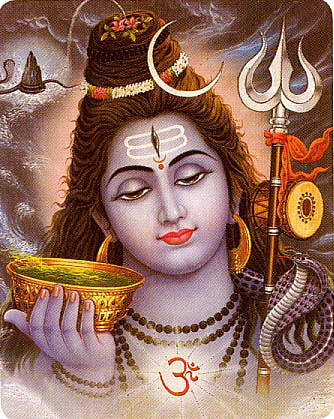
The Powerful God: Shiva is 'shakti' or power, Shiva is the destroyer, the most powerful god of the Hindu pantheon and one of the godheads in the Hindu Trinity. Known by many names - Mahadeva, Mahayogi, Pashupati, Nataraja, Bhairava, Vishwanath, Bhava, Bhole Nath - Lord Shiva is perhaps the most complex of Hindu deities. Hindus recognize this by putting his shrine in the temple separate from those of other deities. Shiva As Phallic Symbol: Shiva, in temples is usually found as a phallic symbol of the 'linga', which represents the energies necessary for life on both the microcosmic and the macrocosmic levels, that is, the world in which we live and the world which constitutes the whole of the universe. In a Shaivite temple, the 'linga' is placed in the center underneath the spire, where it symbolizes the naval of the earth. A Different Deity: The actual image of Shiva is also distinct from other deities: his hair piled high on the top of his head, with a crescent tucked into it and the river Ganges tumbling from his hairs. Around his neck is a coiled serpent representing Kundalini or the spiritual energy within life. He holds a trident in his left hand in which is bound the 'damroo' (small leather drum). He sits on a tiger skin and on his right is a water pot. He wears the 'Rudraksha' beads and his whole body is smeared with ash. The Destructive Force: Shiva is believed to be at the core of the centrifugal force of the universe, because of his responsibility for death and destruction. Unlike the godhead Brahma, the Creator, or Vishnu, the Preserver, Shiva is the dissolving force in life. But Shiva dissolves in order to create, since death is the medium for rebirth into a new life. So the opposites of life and death and creation and destruction both reside in his character. The Most Fascinating of Gods: He is also often portrayed as the supreme ascetic with a passive and composed disposition. Sometimes he is depicted riding a bull called Nandi decked in garlands. Although a very complicated deity, Shiva is one of the most fascinating of Hindu gods. The God Who's Always High!: Since Shiva is regarded as a mighty destructive power, to numb his negative potentials he is fed with opium and is also termed as 'Bhole Shankar', one who is oblivious of the world. Therefore, on Maha Shivratri, the night of Shiva worship, devotees, especially the menfolk, prepare an intoxicating drink called 'Thandai' (made from cannabis, almonds, and milk) sing songs in praise of the Lord and dance to the rhythm of the drums.
Lord Shiva Lord Shiva represents the aspect of the Supreme Being (Brahman of the Upanishads) that continuously dissolves to recreate in the cyclic process of creation, preservation, dissolution and recreation of the universe. As stated earlier, Lord Shiva is the third member of the Hindu Trinity, the other two being Lord Brahma and Lord Vishnu.
Owing to His cosmic activity of dissolution and recreation, the words destroyer and destruction have been erroneously associated with Lord Shiva. This difficulty arises when people fail to grasp the true significance of His cosmic role. The creation sustains itself by a delicate balance between the opposing forces of good and evil. When this balance is disturbed and sustenance of life becomes impossible, Lord Shiva dissolves the universe for creation of the next cycle so that the unliberated souls will have another opportunity to liberate themselves from bondage with the physical world. Thus, Lord Shiva protects the souls from pain and suffering that would be caused by a dysfunctional universe. In analogous cyclic processes, winter is essential for spring to appear and the night is necessary for the morning to follow. To further illustrate, a goldsmith does not destroy gold when he melts old irreparable golden jewelry to create beautiful new ornaments.
Lord Shiva is the Lord of mercy and compassion. He protects devotees from evil forces such as lust, greed, and anger. He grants boons, bestows grace and awakens wisdom in His devotees. The symbolism discussed below includes major symbols that are common to all pictures and images of Shiva venerated by Hindus. Since the tasks of Lord Shiva are numerous, He cannot be symbolized in one form. For this reason the images of Shiva vary significantly in their symbolism.
* The unclad body covered with ashes: the unclad body symbolizes the transcendental aspect of the Lord. Since most things reduce to ashes when burned, ashes symbolize the physical universe. The ashes on the unclad body of the Lord signify that Shiva is the source of the entire universe which emanates from Him, but He transcends the physical phenomena and is not affected by it. * Matted locks: Lord Shiva is the Master of yoga. The three matted locks on the head of the Lord convey the idea that integration of the physical, mental and spiritual energies is the ideal of yoga. * Ganga: Ganga (river Ganges) is associated with Hindu mythology and is the most sacred river of Hindus. According to tradition, one who bathes in Ganga (revered as Mother Ganga) in accordance with traditional rites and ceremonies on religious occasions in combination with certain astrological events, is freed from sin and attains knowledge, purity and peace. Ganga, symbolically represented on the head of the Lord by a female (Mother Ganga) with a jet of water emanating from her mouth and falling on the ground, signifies that the Lord destroys sin, removes ignorance, and bestows knowledge, purity and peace on the devotees. * The crescent moon: is shown on the side of the Lord's head as an ornament, and not as an integral part of His countenance. The waxing and waning phenomenon of the moon symbolizes the time cycle through which creation evolves from the beginning to the end. Since the Lord is the Eternal Reality, He is beyond time. Thus, the crescent moon is only one of His ornaments, and not an integral part of Him. * Three eyes: Lord Shiva, also called Tryambaka Deva (literally, "three-eyed Lord"), is depicted as having three eyes: the sun is His right eye, the moon the left eye and fire the third eye. The two eyes on the right and left indicate His activity in the physical world. The third eye in the center of the forehead symbolizes spiritual knowledge and power, and is thus called the eye of wisdom or knowledge. Like fire, the powerful gaze of Shiva's third eye annihilates evil, and thus the evil-doers fear His third eye. * Half-open eyes: when the Lord opens His eyes, a new cycle of creation emerges and when He closes them, the universe dissolves for creation of the next cycle. The half-open eyes convey the idea that creation is going through cyclic process, with no beginning and no end. Lord Shiva is the Master of Yoga, as He uses His yogic power to project the universe from Himself. The half-open eyes also symbolize His yogic posture. * Kundalas (two ear rings): two Kundalas, Alakshya (meaning "which cannot be shown by any sign") and Niranjan (meaning "which cannot be seen by mortal eyes") in the ears of the Lord signify that He is beyond ordinary perception. Since the kundala in the left ear of the Lord is of the type used by women and the one in His right ear is of the type used by men, these Kundalas also symbolize the Shiva and Shakti (male and female) principle of creation. * Snake around the neck: sages have used snakes to symbolize the yogic power of Lord Shiva with which He dissolves and recreates the universe. Like a yogi, a snake hoards nothing, carries nothing, builds nothing, lives on air alone for a long time, and lives in mountains and forests. The venom of a snake, therefore, symbolizes the yogic power. * A snake (Vasuki Naga): is shown curled three times around the neck of the Lord and is looking towards His right side. The three coils of the snake symbolize the past, present and future - time in cycles. The Lord wearing the curled snake like an ornament signifies that creation proceeds in cycles and is time dependent, but the Lord Himself transcends time. The right side of the body symbolizes the human activities based upon knowledge, reason and logic. The snake looking towards the right side of the Lord signifies that the Lord's eternal laws of reason and justice preserve natural order in the universe. * Rudraksha necklace: Rudra is another name of Shiva. Rudra also means "strict or uncompromising" and aksha means "eye." Rudraksha necklace worn by the Lord illustrates that He uses His cosmic laws firmly - without compromise - to maintain law and order in the universe. The necklace has 108 beads which symbolize the elements used in the creation of the world. * Varda Mudra: the Lord's right hand is shown in a boon- bestowing and blessing pose. As stated earlier, Lord Shiva annihilates evil, grants boons, bestows grace, destroys ignorance, and awakens wisdom in His devotees. * Trident (Trisula): a three-pronged trident shown adjacent to the Lord symbolizes His three fundamental powers (shakti) of will (iccha), action (kriya) and knowledge (jnana). The trident also symbolizes the Lord's power to destroy evil and ignorance. * Damaru (drum): a small drum with two sides separated from each other by a thin neck-like structure symbolizes the two utterly dissimilar states of existence, unmanifest and manifest. When a damaru is vibrated, it produces dissimilar sounds which are fused together by resonance to create one sound. The sound thus produced symbolizes Nada, the cosmic sound of AUM, which can be heard during deep meditation. According to Hindu scriptures, Nada is the source of creation. * Kamandalu: a water pot (Kamandalu) made from a dry pumpkin contains nectar and is shown on the ground next to Shiva. The process of making Kamandalu has deep spiritual significance. A ripe pumpkin is plucked from a plant, its fruit is removed and the shell is cleaned for containing the nectar. In the same way, an individual must break away from attachment to the physical world and clean his inner self of egoistic desires in order to experience the bliss of the Self, symbolized by the nectar in the Kamandalu. * Nandi: the bull is associated with Shiva and is said to be His vehicle. The bull symbolizes both power and ignorance. Lord Shiva's use of the bull as a vehicle conveys the idea that He removes ignorance and bestows power of wisdom on His devotees. The bull is called Vrisha in Sanskrit. Vrisha also means dharma (righteousness). Thus a bull shown next to Shiva also indicates that He is the etemal companion of righteousness. * Tiger skin: a tiger skin symbolizes potential energy. Lord Shiva, sitting on or wearing a tiger skin, illustrates the idea that He is the source of the creative energy that remains in potential form during the dissolution state of the universe. Of His own Divine Will, the Lord activates the potential form of the creative energy to project the universe in endless cycles. * Cremation ground: Shiva sitting in the cremation ground signifies that He is the controller of death in the physical world. Since birth and death are cyclic, controlling one implies controlling the other. Thus, Lord Shiva is revered as the ultimate controller of birth and death in the phenomenal world.
The Puranas vociferously sing the praises of the greatness of the Jyotirlingas. By reciting the name of this, one can eliminate all the sins. The Sadhaka becomes calm, chaste and pure. He becomes illuminated and enlightened with supreme and divine knowledge. The names mentioned for the benefits of all:
SAURASHTRA SOMNATHAM CHA SHRISHAILE MALLIKARJUNAM ||
UJJAINYAM MAHAKALOMKARE MAMMALESHWARAM ||
PARLYAM VAIJNATHAM CHA DAKINYAM BHEEM SHANKARAM ||
SETU BANDHE TU RAMESHAM NAGESHAM DARUKA VANE ||
VARANASYA TU VISHWESHAM TRIBAKAM GAUTAMITATE ||
HIMALAYE TU KEDARAM GHURMESHAM CHA SHIVALAYE ||
AETANI JYOTIRLINGANI SAYAM PRATAHA PATHENNARAHA ||
SAPTA JANMA KRITAM PAPAM SMARANEN VINASHYATI ||
One who recites these 12 names regularly in the morning and evening he washes all the sins committed in the previous 7 births and attains all the powers and Siddhis.
Parad is regarded as the sperm (seed) of Lord Shiva and in Ayurveda it as a flowing metalloid (fluid metal).It is said in Brahma Purana that he who worships Parad Shivling devotedly, whether one is male or female, Brahmin, Kshatriya, Vaishya or Shudra gets full wordly pleasures, and at last attains supreme destination (salvation). During life-span they get glory, honour, high office, name and fame, sons, grandsons and learning. Parad Shivlinga is a very rare Tantrik article. It is belived that even by touching the energised Parad Shivling, one's sins are removed. It is recommended by our saga's to adore and worship parad Shivling,. this lead them to be infused with extra ordinary ,velour invincibility, adding to their fame and popularity far and wide, causing and spreading almost whole over the world. It is best recommended for Peace, prosperity and happiness. It is not only matchless but also unparallel in whole world. Mercury has property of liquidity which in itself involves difficult process of solidification. But by the grace and compassion of Lord Shiva parad shivling is made for the benefit of people of the world for peace and prosperity.
Benefits of Parad Shivlinga :-
o Prosperity to the house or office o No shortage of food, money or clothes. o Brings peace to the premises. o If kept in the bedroom, it brings harmony among the couple. o If kept during a religious gathering, it brings knowledge by evoking Goddess Saraswati. o Enlightens the students with knowledge and sharpens their memory. o Fill it with Ganges water and sprinkle it on a person or in a premises. Malefic planetery effects and black magic evils disappear. o Removes ill-effects of Brahmhatya, Gau-hatya and Bal-hatya (Dosha due to killing of a priest, cow or a child in the previous births.
Shiva (Sanskrit: Auspicious One) is one of the main deities of Hinduism that is worshipped as the paramount lord by the Shaivaite sects of India. In Hinduism, Lord Shiva is regarded as the representation of the Supreme Being. He is known as the third element in the Hindu Trinity (Trimurti), the other two members being Lord Brahma - the creator and Lord Vishnu - the protector. Shiva is the destructive form of the Almighty. As the cycle of destruction and recreation is always in a circle, Shiva’s primary responsibility is maintaining the life cycle. Scholars say, as the Mahakaal, Shiva destroys and dissolves everything into nothingness but as Shankara, he also reproduces that which has been destroyed and dissolved. His symbol of Lingam or the phallus represents this reproductive power.
Lord Shiva is also considered to be the most unique of all Hindu gods and also the God of all. A great ascetic, Shiva is the only godhead who is forever in deep meditation, totally absorbed in contemplation in His abode, Kailaasa Mountain in the great Himalaya. Lord Shiva is also said to be inseparable from Shakti - Parvati the daughter of Himavaan - Haimavati. There is no Shiva without Shakti and no Shakti without Shiva, the two are one - or the absolute state of being.Shiva is often shown with many faces, as creator, destroyer and preserver in total command of the cosmos. He contains both good and evil. He is moody, free of inhibitions, easy to please, protector of the down trodden, and has the power to alter the laws of destiny. Thus, it is Lord Shiva is known as the God of mercy and kindness. He protects his devotees from all evil that are always around us. He blesses his followers with grace, knowledge and peace.
Shiva as ArdhanareeswaraLord Shiva is said to be half man and half woman. In the full figure of Siva the male and female principles are united. Shiva Linga - the symbol of Lord Shiva which consists of both Lingam (phallus) and yoni (the female organ) represent the totality of his nature and the totality of all created existence.
God Nataraj where his dance is to the beat and rhythm of creation. He is also shown in sculptures with many hands. One pair of hands, for example, represents the balance between life and death. Shiva is 'tri netra' or three eyed, and is 'neela kantha' - blue-necked (having consumed poison to save the world from destruction). Besides, there are a lot many attributes associated with Lord Shiva. Here is a brief description of some of the important symbols thatdepict Lord Shiva. Each of his depiction signifies a different aspect of his Supreme Being.
Unclad body covered with ashes: This form of Lord Shiva depicts that Lord Shiva’s presence is much higher than this physical phenomenon. According to some scholars, Shiva’s body smeared with cemetery ash points to the philosophy of the life and death and the fact that death is the ultimate reality of the life.
Jata (Matted Hair):The flow of his matted hair represents Shiva as the Lord of Wind or Vayu, who is the subtle form of breath present in all living beings. Thus it is Shiva which is the lifeline for all living being. He is Pashupatinath.
Sacred Ganga:The holiest of the holy rivers, Ganga flows from the matted hair of Shiva. According to a legend, Shiva allowed an outlet to the great river to traverse the earth and bring purifying water to human being. Ganga also denotes fertility - one of the creative aspects of the Rudra.
The Third Eye:Lord Shiva is known as the three eyed Lord or Tryambaka Deva. The sun is his right eye, the moon left while the third eye of Shiva on his forehead is the eye of wisdom. It is the eye that looks beyond the obvious. The third eye can search evil from anywhere and destroys it completely.
Half-Open Eyes:The half-open eyes show that the universes cycle in process. When the eyes are completely closed it signifies the dissolvent of the universe and when it is completely open a new cycle of creation begins.
Crescent:Shiva bears on his head the crescent of the panchami (fifth day) moon. This is placed near the fiery third eye and this shows the power of Soma, the sacrificial offering, which is the representative of moon. It means that Shiva possesses the power of procreation along with the power of destruction. The moon is also a measure of time, thus Crescent also represent his control over time.
The Cobra Necklace:This suggests that Shiva is beyond the powers of death and is often the sole support in case of distress. He swallowed the poison kalketu for the wellbeing of the Universe. The deadly cobra represents that “death” aspect that Shiva has thoroughly conquered. The cobras around his neck also represent the dormant energy, called Kundalini, the serpent power. The snake curled three times around the neck of Lord Shiva depicts the past, present and future time. The snake looking in the right direction of Lord Shiva signifies that the Lord's perpetual laws of reason and justice preserve natural order in the universe.
The Vibhuti:Vibhuti is a three line of ashes drawn on the forehead that signifies the Immortality of the soul and manifested glory of the Lord.
Tiger Skin:Lord Shiva is shown sitting on or wearing a tiger skin. The tiger is the vehicle of Shakti, the Goddess of power and force. Shiva is beyond and above any kind of force. He is the master of Shakti. The tiger skin that he wears symbolizes victory over every force. Tiger also represent lust. Thus sitting on Tiger skin, Shiva indicates that he has conquered lust. The Elephant & Deer Skin:Shiva also wears elephant skins. Elephants represent pride. Wearing elephant skin, Shiva indicates that he has conquered pride. Similarly deer represent the flickering mind. Shiva wears deer skin which indicates that he has controlled the mind perfectly.
Rudraksha Necklace: ‘Rudra’ is the other name of Shiva. It also means strict or uncompromising and ‘aksha’ means eye. Rudraksha, the necklace worn by Lord Shiva shows that he is firm about his cosmic laws and to maintain law and order in the universe. The necklace has 108 beads, which symbolize the elements used in the creation of the world.
Damaru (Drum): A small drum with two sides alienated from each other by a thin neck-like structure represents the two utterly different states of existence, unclear and clear. When a damaru is shaken, the sound formed denotes Nada, the cosmic sound of AUM, which can be heard during deep meditation. Trishul (Trident): A three-branched trident shown adjoining to Lord Shiva symbolizes His three fundamental powers will, action and knowledge. As a weapon the trident represents the instrument of punishment to the evil doer on all the three planes - spiritual, subtle and physical.
Nandi, the Bull: Nandi is said to be the vehicle of Lord Shiva. The bull represents both power and ignorance. Lord Shiva's use of the bull as his vehicle expresses the idea that He removes ignorance and bequeaths power of wisdom on His followers.


 Lord Shiva